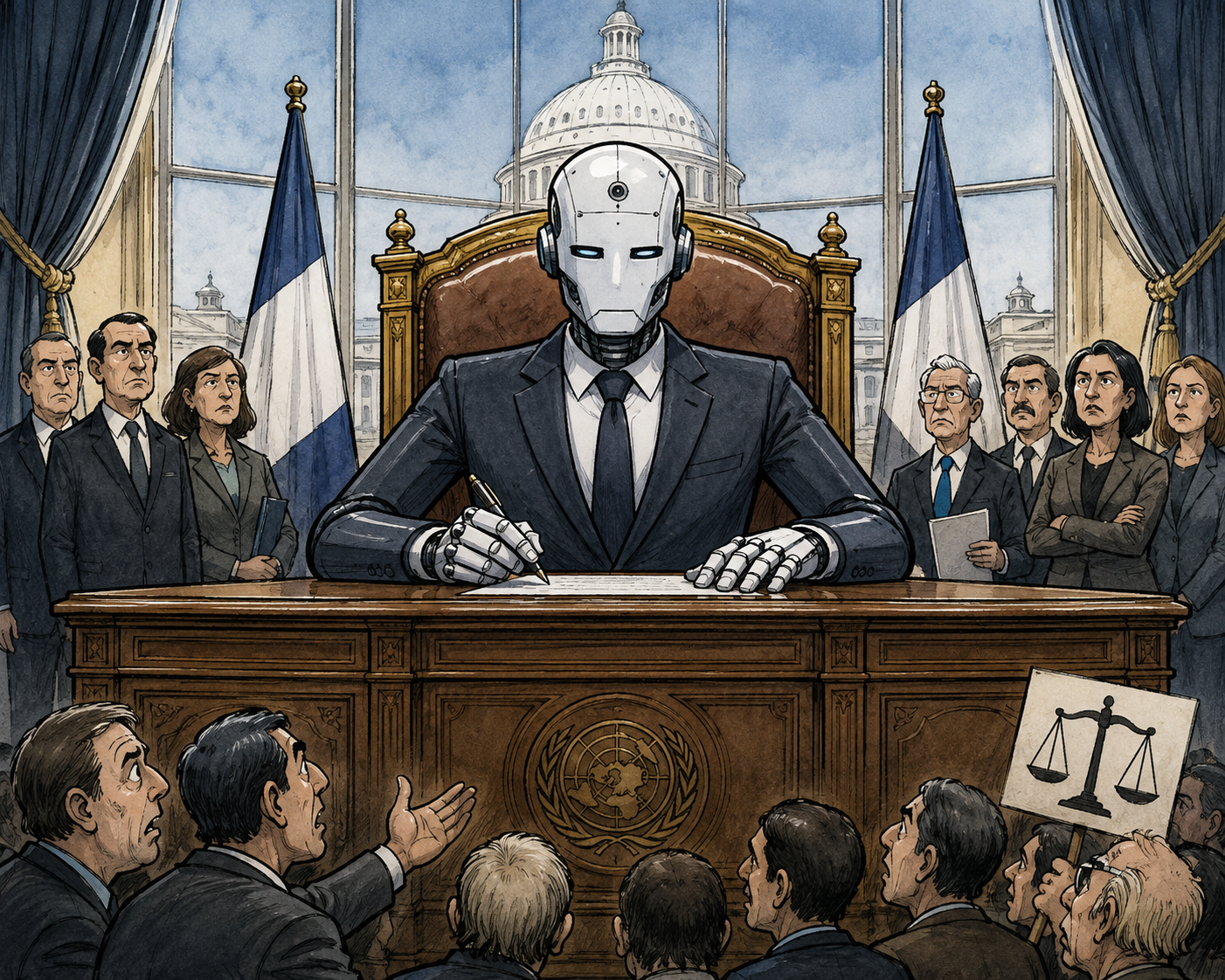
We may be witnessing a political revolution as profound as the one that gave birth to representative democracy more than two centuries ago. After gradually replacing physical force with the rule of law, and then the rule of law with technocracy, our societies may one day be tempted to replace political leaders themselves with artificial intelligence. The idea sounds absurd. Yet it is far less far-fetched than it first appears.
Never before have Western democracies expressed such profound distrust of those who govern them. Voter abstention continues to rise, traditional political parties are collapsing, governing coalitions have become increasingly fragile, and successive elections often produce the impression of identical public policies under different faces. At the same time, hundreds of millions of people consult artificial intelligence every day to draft emails, solve problems, support decision-making, or organize their work. We already trust machines to think alongside us. Why would we one day refuse to let them govern alongside us?
AI at the Helm
We already ask artificial intelligence to write speeches, diplomatic briefs, corporate strategies, administrative decisions, expert reports, military analyses, medical diagnoses, and even draft judicial opinions. Why should we continue electing leaders expected to produce themselves what algorithms can now generate in seconds?
Artificial intelligence also possesses qualities that have become increasingly rare in politics. It does not embezzle public funds, create fictitious jobs, rely on patronage networks, consult hidden advisers, or maintain secret offshore bank accounts. It neither ages nor tires. It does not govern under the influence of anger, ego, or personal ambition. It works continuously and can instantly analyze millions of data points that no human mind could ever absorb. At first glance, it resembles the ideal leader. It already understands political platforms, masters volumes of information inaccessible to any human brain and, in theory, responds without yielding to the passions of the moment.
Leaders Already Stripped of Much of Their Power
Yet this provocation reveals a much deeper reality. What do we still truly expect from a head of state? Across much of the democratic world, national room for maneuver continues to shrink. Financial markets impose their constraints. Central banks control monetary policy. International organizations, supranational courts, economic agreements and climate commitments increasingly limit political choices. Governments are often managing rather than genuinely governing.
Election campaigns have also become strikingly similar. Slogans change, posters evolve, candidates come and go, but the promises remain remarkably familiar: greater security, slightly lower taxes, tighter immigration control, stronger purchasing power, pragmatic environmental policies and a more efficient state. Differences certainly exist, but the prevailing impression is that politics has become primarily an exercise in management. Management, however, is precisely what algorithms excel at. It is therefore inevitable that some will eventually ask whether artificial intelligence might perform this managerial role more effectively than political leaders whose freedom of action appears increasingly constrained.
Toward AI-Assisted Global Governance?
The real question now extends far beyond national elections. As global crises multiply—climate change, pandemics, cyberattacks, artificial intelligence itself, financial instability, hybrid warfare and migration—the solutions increasingly require global coordination. Why would some not eventually conclude that artificial intelligence is better equipped than national leaders to reconcile these competing interests?
An AI system could model thousands of diplomatic, economic or military scenarios before every major decision. It could anticipate unintended consequences, evaluate fiscal impacts in real time, calculate environmental costs and detect geopolitical risks with unprecedented analytical power. It would become less a political leader than a sophisticated operating system for governing complexity. In highly technological societies, such a future might even appear as a logical evolution rather than a dystopian nightmare.
But Can Democracy Survive Without Human Incarnation?
This is where the real obstacle emerges. Democracy is not merely a system of optimization. Citizens do not elect only a manager. They also choose a human embodiment of the nation.
A president, prime minister or constitutional monarch represents history, memory and continuity. They reassure a nation in times of crisis, assume responsibility for failure, mourn alongside the people, celebrate national victories and speak when everything seems to be collapsing. Between a people and those who govern them exists an almost visceral relationship built on emotion, trust and sometimes genuine affection. No algorithm, however sophisticated, is likely ever to replace this profoundly human dimension completely. Nations do not live by statistics alone. They also live through stories, symbols, traditions and a shared understanding of who they are.
The Paradox of Our Time
Perhaps the greatest irony lies elsewhere. It may not be machines that replace human beings—it may be human beings who gradually begin governing like machines. As political leaders increasingly rely on dashboards, performance indicators, predictive models, permanent polling and carefully crafted messaging, many already appear less like statesmen than executors of a vast algorithmic logic.
The boundary between human governance and artificial governance is steadily fading, especially as AI tools become active participants in public decision-making, military planning, public administration, healthcare policy and judicial systems. The question is therefore no longer whether artificial intelligence will participate in governing democracies. It already does. The real question is how much sovereignty we will ultimately be willing to delegate to it.
A fundamental contradiction nevertheless remains. Today’s most powerful AI systems are developed by a handful of private companies, overwhelmingly based in the United States. They are neither politically neutral nor sovereign. The day a democracy delegates a decisive share of its governing authority to an artificial intelligence designed abroad, it will also surrender part of its strategic autonomy. Digital sovereignty will then become just as essential as political sovereignty.
Perhaps the future lies neither in democracies governed by machines nor in democracies that stubbornly reject them. More likely, it will emerge from a new equilibrium in which artificial intelligence supports political power without ever fully replacing it. Governing is not merely about calculating the optimal decision. It also means embracing uncertainty, assuming moral responsibility and, at times, choosing against the numbers in the name of values, culture and a particular vision of humanity.
Artificial intelligence will probably become the finest adviser political leaders have ever possessed. The real hope is that democracies will continue to produce women and men capable of bearing, alone, the ultimate burden of political decision-making. For the day a people chooses to entrust its destiny to a machine rather than to one of its own, it will probably not mark the triumph of artificial intelligence. It may instead be the clearest admission that our democracies have reached the limits of their own exhaustion.