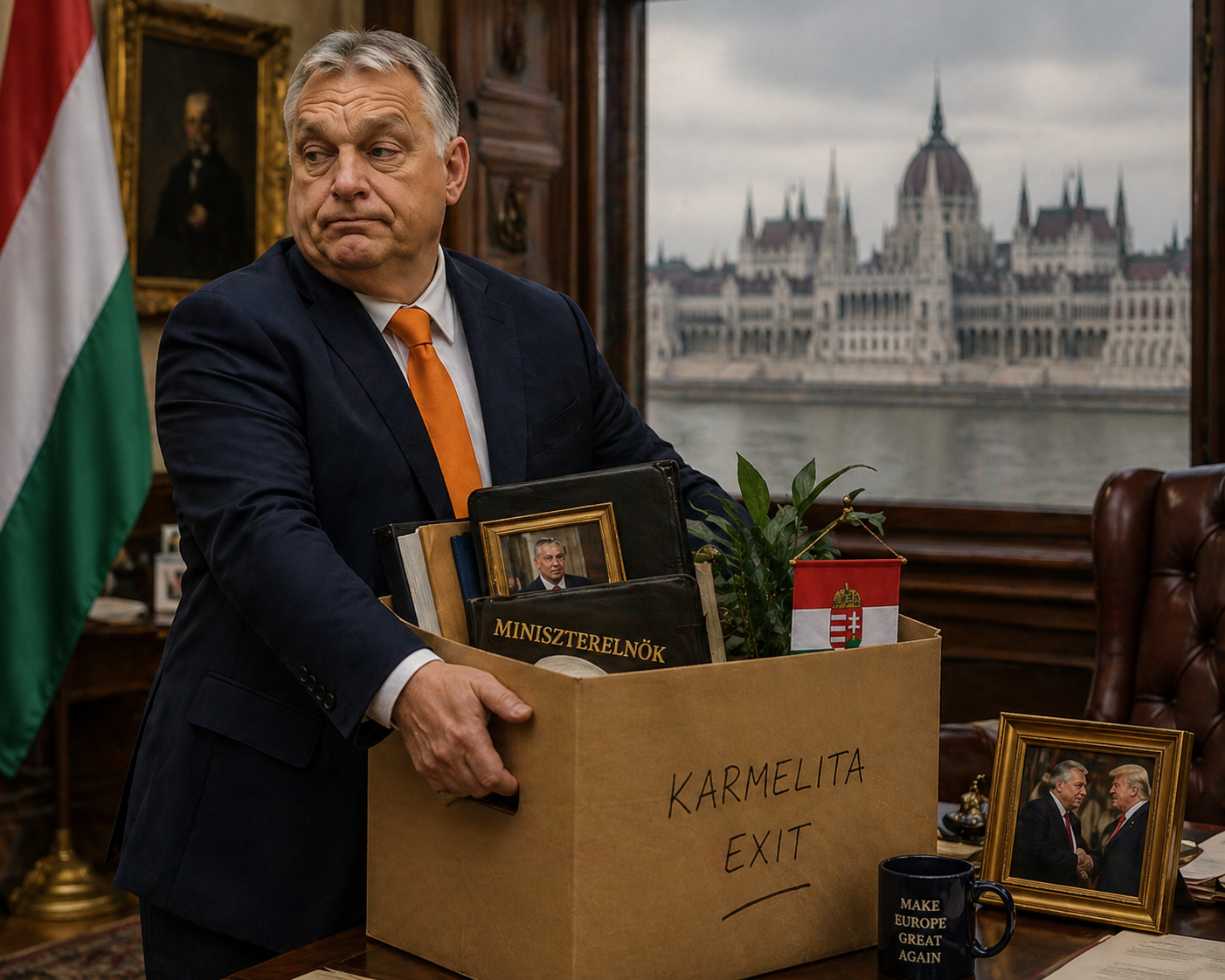
In Hungary, a democratic election has brought to an end sixteen years of almost uninterrupted rule by a leader whom many in Europe have consistently labeled as anti-democratic. On the night of the vote, the European left celebrated what it saw as a liberation. Yet day by day, disillusion has set in, as the new Prime Minister, Péter Magyar, may not be quite the great humanist savior he claimed to be during the campaign. Such a radical turnaround in less than two years, given that he was once close to the former prime minister, should have raised some suspicions.
Viktor Orbán’s Hungary was undoubtedly illiberal, but not strictly anti-democratic, despite very real excesses that gradually intensified over time with the wear of power. And yet, Orbán left office without contestation, acknowledging his defeat and congratulating his opponent, Péter Magyar, a former well-regarded diplomat at Hungary’s Permanent Representation in Brussels and now head of government. A man, therefore, from within the very camp of the ousted prime minister, and the ex-husband of Judit Varga, who served as Minister of Justice under Orbán from 2019 to 2023, the year of their divorce. As late as the end of 2023, Magyar was still at the heart of the system, and his wife one of the regime’s central figures. But no matter, the sentimental European left must not be disturbed.
This starting point should have invited a degree of caution in the rapid analyses that flourished upon the arrival of this supposed harbinger of spring. For if Orbán, long nicknamed “Viktator” by his critics, has left power, this does not mean the disappearance of what he embodied, nor even its deep rejection by European societies. Quite the contrary. What he represented for over a decade has taken root in the continent’s political landscape.
For more than fifteen years, Orbán was not merely a provocative and radical leader. He was a symptom. A manifestation of a deep European malaise, born of the 2008 financial crisis, amplified by the 2015 migration crisis, and since nourished by a succession of economic, identity, and geopolitical shocks. In Budapest, this malaise found a blunt, unapologetic, and theorized expression. Elsewhere, it has spread more subtly, yet just as durably.
Much has been said about the “Orbánization” of Europe as a deviation. That was a mistake. It was not an isolated case on the old continent, but rather a structural trend. A way of governing in tension with common rules while remaining within the system to reap its benefits. Orbán did not invent this reflex; he radicalized it. And that is precisely why his defeat does not fundamentally change the situation.
Today’s Europe is filled with governments that have learned the lesson. Not that of direct confrontation, but of calibration. Less provocation, more calculation. Less overt rupture, more strategic ambiguity. Where Orbán confronted Brussels head-on, others prefer to negotiate, bypass, or slow things down. The result is often similar, but the method is more effective, more acceptable, and therefore more durable.
In this regard, the example of Giorgia Meloni in Italy over the past three years is telling. Coming to power with an image of rupture, she quickly adopted a pragmatic stance. Pro-European in discourse, firm on national interests, and skillful in leveraging European mechanisms without positioning herself in direct opposition. A kind of rationalized Orbánism. Less spectacular, but potentially more influential. While her economic results are still unfolding, given how far Italy had to recover, she continues to face constant criticism from those within the European Union who fear her. Otherwise, she would be met with indifference. Instead, she has repositioned Italy at the heart of the continent’s geopolitical dynamics.
This shift, far from being an exception, reveals much about the evolution of Europe. The European Union is no longer openly contested. It is now being reshaped from within by logics of selective sovereignty. Membership is accepted, but on the condition that its margins are redefined. Rules are respected, but interpreted. Cooperation continues, but without naivety. This hybrid Europe is precisely the ground on which Orbán’s legacy is likely to thrive.
One essential question remains: why did he fall? Certainly not for the reasons some would like to highlight. It was neither his confrontational relationship with Brussels nor his sovereignist rhetoric that brought him down. The answer lies elsewhere, primarily in the economy, not in rights violations. It was his inability, over time, to meet the concrete expectations of a portion of the population. Governing through confrontation may help one seize power, but it is not enough to sustainably generate prosperity, social stability, and credible prospects.
This is the limit that ultimately emerged. Not the failure of a narrative, but of performance. And this is precisely what other European leaders have understood. They retain the political markers that resonate with their electorates while ensuring they are not trapped in a permanent logic of obstruction. Yet the economic hurdle is becoming increasingly difficult to overcome, for both radical and moderate leaders alike.
The war in Ukraine has, on the surface, tightened European ranks. It has reduced the most visible margins of maneuver, particularly on energy and strategic issues. But it has not erased deeper reflexes. The temptation of national calculation, targeted protection, and opportunistic positioning remains. It is simply expressed in a more subdued manner.
This is where the real misunderstanding lies. The European Union believes it has turned a page. In reality, it has merely changed chapters. The underlying causes that enabled Orbán’s rise are still present: a sense of decline, territorial fractures, and a perceived loss of control over economic, migratory, and cultural issues. As long as these dynamics persist, they will continue to generate similar political responses.
Orbán’s defeat, therefore, settles nothing, despite what many enthusiastic Europhiles have been trying to suggest in recent days. It merely sweeps the dust under the rug for a while. The fall of the “lider magyaro” (magyar meaning Hungarian) opens a new phase, more discreet, more complex, less visible, but undoubtedly more turbulent beneath the surface. The era may no longer be one of openly divisive figures, but of leaders capable of combining European loyalty with national assertion, integration with power politics, while ultimately pursuing similar objectives.
In this sense, Europe is entering a period of sustained turbulence. Less spectacular, but more strategic. “Orbánization” did not die with Orbán. It has changed form. And that is precisely why it is likely to endure. The first strong statements by Péter Magyar upon leaving the Sándor Palace in Budapest, the presidential residence, set the tone: President Tamás Sulyok must go. The purge of the entire Orbán system and those who contributed to it has begun. At a press conference, Magyar emphasized institutionalized corruption under the former prime minister, the importance of relations with the European Union, and… immigration.
And here, the European left is already beginning to regret its enthusiasm. Magyar remains tough on the issue, shaped both by Hungary’s political legacy and by an electorate that remains deeply conservative. In September 2024, while already in opposition, he accused the government of bringing in 60,000 economic migrants from Asia each year and of prioritizing multinational profits over the security and living standards of Hungarians. At the time, he even cited the concrete case of the rural region of Vitnyéd in western Hungary. His argument against Orbán’s supposed betrayal of the anti-immigration pact was that it drove down property prices and fueled anxiety among residents unaccustomed to welcoming foreigners. Since then, Magyar has multiplied shock announcements: temporary suspension of public television (in the name of purging it of the previous regime’s influence), a halt to programs importing non-EU workers, and a cautious, partial reconciliation with Europe, particularly on Ukraine. So be it.