by Ines Armand
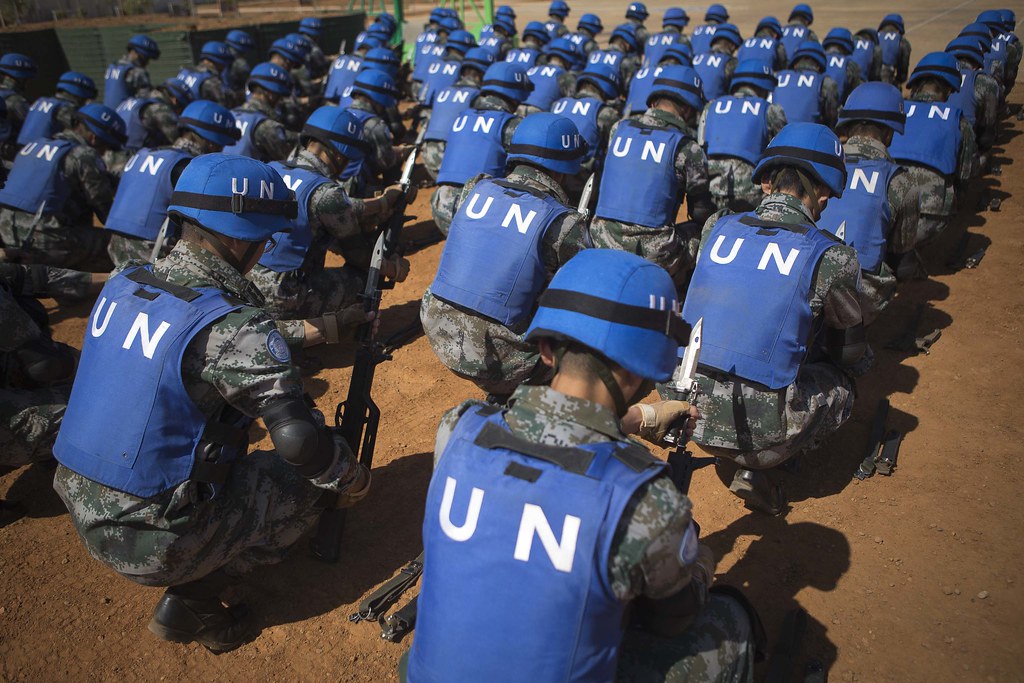
Faced with a number of armed conflicts unprecedented since 1945, António Guterres wants to “overhaul” United Nations peace operations. The assessment is as simple as it is daunting: the peacekeeping model, designed to stabilise wars that were nearing their end, is increasingly ill-suited to conflicts that are becoming protracted, internationalised and technologically sophisticated. Behind this reform lies a more fundamental question: how can an organisation designed to preserve a relatively stable international order operate in a world where that order is fragmenting? The answer may lie in Geneva.
There is something deeply symbolic about António Guterres’s assessment: the world is currently experiencing the highest number of armed conflicts since 1945. Yet 1945 was precisely the year in which the international order, of which the United Nations is one of the principal pillars, was born. The San Francisco Charter was founded on one conviction: after two world wars, collective security had to prevent another global conflagration.
Eight decades later, the organisation acknowledges that its strategic environment has profoundly changed. Interstate conflicts are re-emerging, civil wars are becoming internationalised, armed groups have access to increasingly sophisticated technologies, and regional and external powers intervene directly or indirectly in conflicts that are no longer purely domestic. The question, therefore, is no longer simply where to deploy peacekeepers. It is whether instruments devised in the twentieth century are still capable of building peace in the twenty-first.
The Paradox of UN Peacekeepers
Peacekeeping rests on an almost paradoxical principle: an international force can help preserve an equilibrium when the belligerents have agreed, at least temporarily, to stop fighting. But what happens when no such agreement exists? This is one of the fundamental limitations confronting UN operations today. As António Guterres puts it: “There is no peace to keep where there is no peace.”
The phrase may seem self-evident, but it marks an important turning point. For decades, peacekeeping operations were often deployed in the aftermath of conflict, with the task of supporting a political process, securing a transition and protecting civilians. Yet peace agreements are becoming rarer, more fragile and more difficult to negotiate. Contemporary conflicts do not necessarily produce a victor and a defeated party ready to negotiate. They can turn into wars of attrition sustained by external funding, trafficking, regional rivalries or foreign intervention.
Under such circumstances, a UN operation risks becoming trapped: present enough to become a target, but neither powerful enough nor sufficiently supported politically to impose a solution. Sudan brutally illustrates this difficulty: when the parties to a conflict enjoy external backing and have no interest in ending hostilities, an international presence alone cannot create the political will for peace.
The Time for Diplomacy, Not Peacekeepers Alone
The reform proposed by the Secretary-General therefore does not mean the end of peacekeeping. Rather, it means that peacekeeping can no longer be the international community’s primary reflex. The first instrument must once again be political. Preventive diplomacy, good offices, mediation, special envoys and the peaceful settlement of disputes: António Guterres’s vocabulary reflects a UN seeking to intervene more effectively before weapons replace negotiation. This represents a major change in perspective.
For many years, the UN’s most visible expression of power was embodied by its peacekeepers, their vehicles, checkpoints and bases. Yet a political mission with strong mediation capabilities can sometimes prove more useful than a large military force deployed too late. Colombia, cited by the Secretary-General, illustrates this logic: the UN’s good offices supported the peace process, the conclusion of the agreement and its implementation. In other words, peace can sometimes be less costly to build than to maintain—provided action is taken early enough.
A Reform Also Driven by Budgetary Constraints
It would nevertheless be naïve to regard this reform solely as a strategic adaptation. It comes at a time when resources devoted to peace operations are declining and military and police personnel are expected to be reduced. The UN must therefore do better with less. Hence the emphasis on missions that are “more focused, agile, flexible and cost-effective.” The report’s 47 recommendations reflect this desire for rationalisation: more precise mandates, regular assessments, clearer chains of command, stronger technological capabilities and earlier preparation of exit strategies.
This financial constraint could, however, have a paradoxical effect. It forces the UN to question the relevance of its missions rather than indefinitely extending operations that have become difficult to finance. But it could also reduce the organisation’s ability to intervene precisely when the need for collective security is increasing. The question, therefore, is whether the reform will genuinely concentrate resources where they are most useful, or simply become a way of managing scarcity.
Warfare Enters the Age of Drones and Artificial Intelligence
Another aspect of Guterres’s assessment is particularly revealing of the transformation of the battlefield. Peacekeeping operations were designed in a world where military technology remained largely conventional. They must now contend with drones, autonomous systems, cyber technologies and the prospect of lethal weapons incorporating artificial intelligence. This evolution is changing the very nature of civilian protection.
A peacekeeper can monitor a road or protect a displaced persons camp. It is far more difficult to defend against a remotely operated drone attack or systems capable of identifying and striking a target without direct human intervention. Technological transformation is therefore not simply a matter of equipment. It raises a fundamental legal and ethical question: who will be responsible when a machine takes part in the decision to kill? The UN thus faces a contradiction: it must modernise its operations to remain relevant while helping to establish limits on military technologies whose rules of use remain largely undefined.
Peace Cannot Be Imported
The report also emphasises a principle that could become one of the foundations of the UN’s new doctrine: “Peace cannot be imported.” An international operation can provide security, protection, monitoring and support. It cannot permanently substitute itself for national institutions. This evolution points towards stronger partnerships with host countries and regional organisations.
The African Union has a particularly important role to play here. Africa is home to several of the crises in which peacekeeping has become most complex. Closer cooperation between the UN and African organisations therefore appears to be one of the key elements of the reform. The logic is pragmatic: regional actors often possess a better understanding of political and social realities and can intervene more rapidly. The UN, for its part, can provide international legitimacy, diplomatic capabilities and a legal framework.
The future of peacekeeping may therefore lie less in a UN acting alone than in a collective security architecture increasingly shared between international and regional organisations.
The Geneva Paradox
This transformation gives particular importance to international Geneva. Geneva is not the political headquarters of the Security Council, nor is it where the UN’s principal military operations are decided. But it remains one of the world’s leading centres of multilateral diplomacy, humanitarian action, international law and conflict prevention.
The reform proposed by António Guterres is based precisely on these dimensions: more diplomacy, mediation, regional cooperation, civilian protection and coordination between international actors. In this new model, peace can no longer be reduced to the deployment of a military force. It requires diplomats, mediators, lawyers, humanitarian workers, human rights experts, development specialists and representatives of civil society.
In other words, the future of peacekeeping could paradoxically strengthen the importance of international Geneva, even as the UN’s military operations face declining resources.
The UN at a Crossroads
The reform announced by António Guterres is ultimately less a technical reform than an acknowledgement of a strategic reality. The UN can no longer assume that conflicts will follow the scenario that prevailed throughout much of the post-war period: a civil war, an agreement, followed by the arrival of peacekeepers to support the transition.
The contemporary world is far more fragmented. Conflicts can involve states, armed groups, militias, criminal organisations and foreign powers. Drones blur front lines. Transnational networks finance wars. Autonomous technologies transform the balance of power. And civilians remain the primary victims. In this context, peacekeeping must become more political, flexible and targeted. But institutional reform alone will not be enough.
The real problem remains political: are states still prepared to invest in multilateralism at a time when international power struggles are intensifying?
The UN can modernise its missions, revise its mandates and improve its technologies. What it cannot do is replace the political will of states to negotiate, exert pressure on belligerents and finance peace mechanisms. This is ultimately the paradox of the reform: at a time when wars are becoming more numerous and sophisticated, the UN has fewer and fewer resources with which to prevent them.
The challenge in the years ahead will therefore be less about determining how many peacekeepers should be deployed than about rebuilding the political conditions that would make their deployment unnecessary. And this may be the real lesson of this review: in a world where war is once again becoming a central reality of international relations, diplomacy is not an alternative to peacekeeping. It is its prerequisite.
Commentaires