
Europolitik is also available in French!
We all remember where we were at that moment. France’s rolling news channels did not yet exist, and the first images came directly from the United States. Images that would run on a loop for days and days, and that nobody has forgotten a quarter of a century later. 11 September 2001 became an unforgettable day in world history.
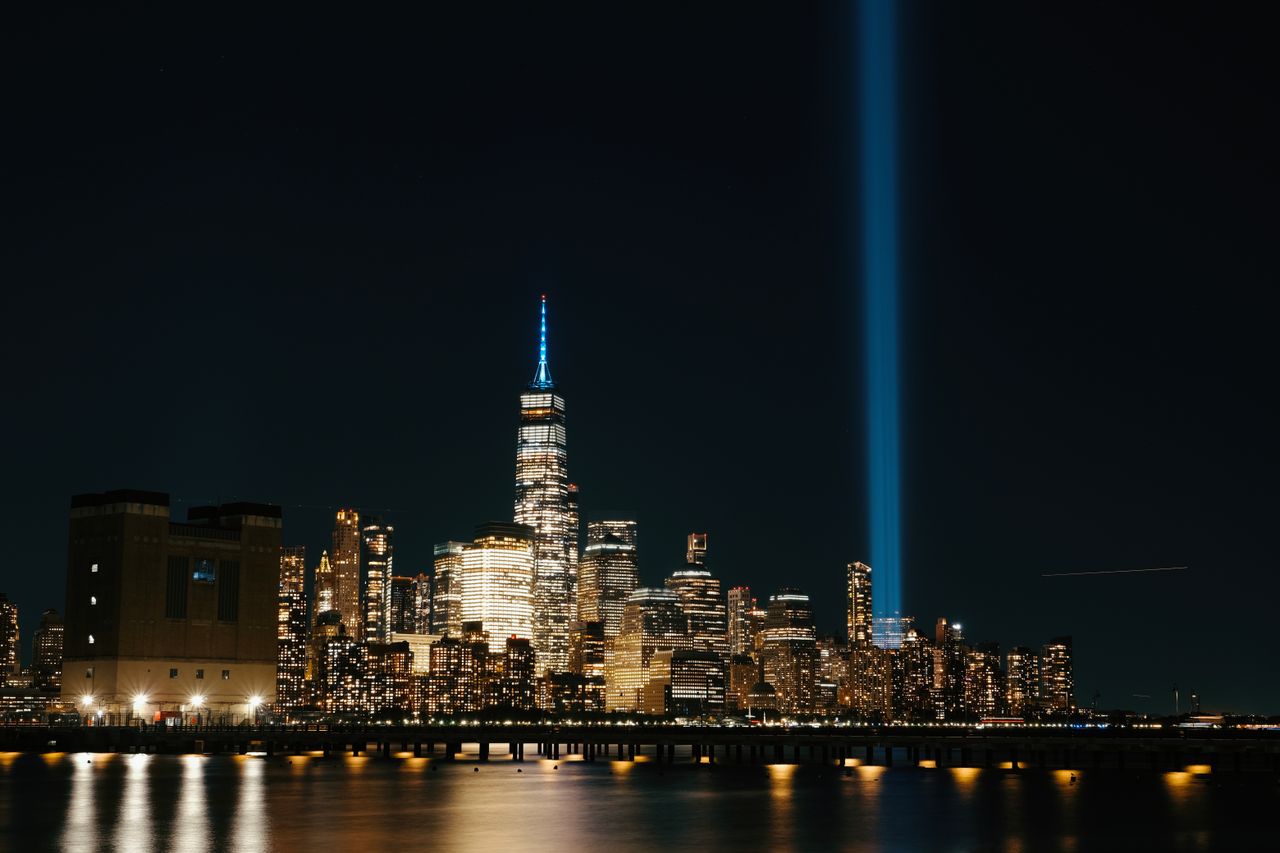
Already twenty-five years ago, two aircraft struck the World Trade Center towers in New York, a third hit the Pentagon and a fourth crashed in Pennsylvania. Nearly 3,000 people died within a few hours. The whole world watched live as America discovered that it could be struck at its heart—and with it, the entire West. In retrospect, perhaps the twenty-first century did not really begin on 1 January 2001. It began decisively that morning at 8:46, when American Airlines Flight 11 slammed into the North Tower. We were about to realise that history was far from over, and that the torpor into which we had sunk after the end of the Cold War had made us forget that new threats were already at work.
The United States struck as never before
The United States was then at the height of an exceptional historical moment. And so, by extension, was the West. The USSR had disappeared ten years earlier, the Cold War was over and Washington appeared to be the world’s sole superpower. Francis Fukuyama had even popularised the idea of an “end of history”. The American economy dominated, its military seemed to have no real rival, globalisation was advancing under a Western flag and the internet promised to bring peoples closer together. Optimism had almost become a geopolitical doctrine.
Then nineteen armed men reminded the world’s leading power that an infinitely weaker adversary could inflict an enormous, lifelong wound. The United States had certainly never been wholly spared violence on its own territory, but never had the American mainland suffered a foreign attack on this scale. Pearl Harbor in 1941 had struck an American base in Hawaii, then an American territory but not yet a state of the Union. The 11 September attacks hit New York and Washington: the economic, military and symbolic heart of American power.
Afghan blowback and the places where jihad regenerated
Osama bin Laden’s name then became known around the world. So did Al-Qaeda’s. Yet the story had begun long before. In the 1980s, Afghanistan became one of the main theatres of indirect confrontation between Moscow and Washington. After the Soviet invasion of 1979, the United States, Pakistan, Saudi Arabia and other powers supported the Afghan resistance. Washington armed and financed mujahideen fighting the Red Army, notably through Pakistan’s intelligence services.
It would be historically false to claim that the CIA simply “created bin Laden”. But the West undoubtedly helped create the strategic environment in which international jihadism would flourish: networks of fighters, considerable funding, military experience and, above all, a victorious narrative. A formidable idea took hold: determined Islamist fighters could force a superpower to retreat. After the Soviet departure from Afghanistan, part of this jihadist international began looking for new fronts.
Algeria in the 1990s, Bosnia, Chechnya and then Taliban-ruled Afghanistan became arenas of combat, of fighters moving between countries and of ideas spreading. With Al-Qaeda, jihad changed scale. The enemy was no longer merely the local regime deemed impious: the West itself became a priority target. The 11 September attacks were the spectacular culmination of this transformation.
From Al-Qaeda to ISIS: twenty-five years of metastasis
The American response would be immense. Afghanistan was invaded in 2001. Then came Iraq in 2003, on the grounds that it possessed weapons of mass destruction that would never be found. Saddam Hussein fell quickly, but the destruction of the Iraqi state opened Pandora’s box. Insurgency, sectarian clashes and then Syria’s collapse would, a few years later, allow an even more ambitious monster to emerge: ISIS. Indeed, many of its future fighters would come from the former Iraqi army, along with numerous jihadist fighters imprisoned by the former dictator and released when the regime collapsed.
Al-Qaeda dreamed of a terrorist international: Osama made it happen. He wanted to export his revolution as the Soviet communists had tried to do. From 2014, ISIS would attempt to build a state on Iraqi and Syrian territory. Caliph al-Baghdadi pursued this goal, seeking to revive the great age of the Arab Umayyad and Abbasid caliphates. At its peak, the organisation controlled a vast territory spanning Syria and Iraq, administered cities, collected taxes, exploited resources, organised global propaganda and recruited tens of thousands of foreign fighters. Never had a terrorist organisation attained such territorial, financial, military and media power. Paris, Nice and Brussels would pay a heavy price in 2015 and 2016, struck at their hearts by the worst attacks in their history.
The “caliphate” was subsequently destroyed territorially in 2017 with the fall of Raqqa. But it would be a mistake to confuse the disappearance of a territory with that of an ideology. Twenty-five years after 11 September, Al-Qaeda has not disappeared. Neither has ISIS. Their offshoots and affiliated organisations continue to operate from the Sahel to Afghanistan, from Somalia to Nigeria, and from the Middle East to Asia. Europe now knows that an individual radicalised in front of a screen, armed with a knife or a car, can sometimes generate as much political terror as an organised cell.
That may be the great lesson of these twenty-five years. We have learned to destroy camps, eliminate leaders, bomb columns of fighters and dismantle networks. But we find it much harder to kill an idea that continues to spread throughout the world using our new tools of global communication.
The endless war
The jihadism of 2026 is no longer that of 2001. It has adapted to its era. Afghan training camps have been supplemented by social media, encrypted messaging, the dark web, cyberspace and drones. A hierarchical organisation can give way to a local franchise, a small autonomous group, or even an individual radicalised thousands of kilometres from the organisation’s historical centre. Both ISIS and Al-Qaeda have spawned numerous branches across the planet.
Above all, this violence does not target only the West. The foremost victims of jihadism are very often Muslims themselves: populations, religious leaders, states or communities declared apostates or unbelievers. The project is totalitarian before it is geographical. It seeks to impose a worldview and destroy those who resist it, whether they live in Paris, Brussels, Baghdad, Bamako, Kabul or Mogadishu.
Looking at the record of these twenty-five years, it is hard to speak of a definitive Western victory when the West still understands nothing of these groups and the many-tentacled phenomenon of jihad. Iraq, invaded in 2003 to overthrow Saddam Hussein, endured two decades of chaos, sectarian violence, insurgencies and attacks before regaining relative stability, which remains fragile. It was precisely on the ruins of the Iraqi state and amid Syria’s parallel collapse that ISIS was able to build its caliphate. That caliphate has disappeared, but the organisation continues to exist. In Syria, its clandestine cells continue their attacks, ambushes and assassinations. The black flag no longer flies over Raqqa, but those who thought they had buried ISIS along with its territory confused a military victory with an ideological one.
Afghanistan presents an even crueller picture. For twenty years, the United States and its allies spent colossal sums, lost thousands of personnel, trained an Afghan army and tried to build a state capable of surviving a Western withdrawal. In August 2021, it took only a few weeks for the edifice to collapse. The Taliban, driven from Kabul in autumn 2001, returned twenty years later. America was leaving Afghanistan while its former enemies regained power. It is difficult to imagine a more brutal symbol of the limits of military power when it claims to transform a society for good.
History does not end there. Twenty-five years after 11 September, Donald Trump is in turn confronting an Islamic Republic of Iran whose capacity to cause harm he had hoped to break and whose regime he had hoped to force into retreat. Despite military, economic and diplomatic pressure, Tehran continues to demonstrate its capacity for resistance, adaptation and regional destabilisation. Once again, the West is rediscovering an old lesson: one can destroy facilities, eliminate leaders, sanction an economy or weaken an organisation; it is infinitely harder to eradicate an ideological system that has organised its own survival.
Perhaps that is ultimately the most troubling legacy of 11 September. We thought we were witnessing an extraordinary attack, in the sense of something sufficiently rare that it could not happen again. In reality, we were entering a quarter-century of wars against adversaries whose main strength lies in their ability to survive their own defeats. For twenty-five years, the West has repeatedly made the same mistake: believing that military victory alone can produce ideological victory.
Bin Laden is dead. ISIS’s territorial caliphate has fallen. Saddam Hussein was overthrown. Thousands of jihadists have been killed or imprisoned. The Taliban were driven out before returning to power twenty years later. The Islamic Republic of Iran has been sanctioned, isolated and struck without the system sustaining it disappearing after six months of war and the efforts of a powerful Israeli-American coalition. We know how to eliminate leaders, retake cities, destroy infrastructure, cut off funding and dismantle cells. But an ideology has no capital to conquer, no regular army to force into surrender and no border behind which it can be pushed.
That is precisely what makes radical Islamism and jihadism so difficult to combat. They can lose territory and win a mind. They can lose a leader and recruit a generation. They can abandon a training camp only to reappear on a mobile phone in Brussels, Paris, Kabul, Islamabad, Dhaka, Bamako, Jakarta, Benghazi or Baghdad. Their ability to adapt is immense because their true territory is not only geographical: it is mental, religious, political and now digital. As long as collapsed societies, failed states, identity-based frustrations, radicalisation networks and individuals willing to turn resentment into a totalitarian project persist, this ideology will find places in which to thrive. That is the paradox of the ideology that has threatened us for a quarter of a century: the more it is struck, the more it seems to flourish. It is a profoundly deadly ideology that has, so far, proved almost immortal.

Comments