
By Sébastien Boussois, political science researcher and director of the European Geopolitical Institute (IGE)
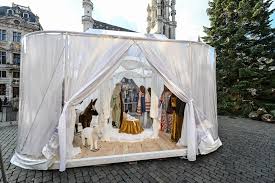
For 48 hours, yet another controversy has refused to subside in Belgium over the installation of the new Christmas nativity scene on one of the world’s most beautiful squares, Brussels’ Grand Place, in the very heart of Europe and beside a splendid traditional Christmas tree. The new nativity scene resembles a construction-site tent. It is supposedly inspired by the Royal Greenhouses of Laeken! Although initially covered and sheltered from prying eyes, the first photographs had already reached the press, also flooding the French media, which gave them extensive coverage from the earliest days, even before the opening of “Winter Wonders 2025”. This supposedly “innovative” work depicts Mary, Joseph and the cradle intended for Jesus as faceless figures made of reclaimed fabric, in an installation worthy of a second-hand clothes shop in a provincial town. The first problem: the figure resembling Jesus was already there, and its head was stolen within the first hours of opening. But what was Jesus already doing in the cradle before 25 December? A mystery. As for the scarecrows representing the Holy Family, they are quite enough to frighten children, who are supposed to come here to enjoy the event’s magic—one of Christianity’s most beautiful celebrations, the birth of Jesus—and all the luminous, fairy-tale wonder that still dresses a city even greyer than usual in the depths of a dark winter. It is a celebration that extends beyond Christians: in Japan, for example, Japanese people of the Shinto tradition celebrate Christmas. The magnificent Grand Place at Christmas had still stood as an exception to the city’s overall aesthetic decline.
In Brussels, Christmas is already no longer quite Christmas. What was long a period of anticipation, celebration and a diffuse sense of the sacred has gradually dissolved into a semantic and symbolic dilution manipulated by the political class in power, which wants to please as many people as possible. It has failed, starting with those most directly concerned: Christians. For several years, the capital has already fallen into the habit of an “event-based” and “secular” Christmas: less religious, more commercial, more festive and more consensual. Back in 2012, the municipal decision to replace the name “Christmas Market” with “Winter Wonders” sent political shockwaves: some saw an embrace of multiculturalism, others a distancing from Europe’s religious cradle. But renaming things has consequences. Words establish a narrative, a direction, sometimes an opening-up, sometimes a loss, which today leaves more than a few people bewildered. Brussels seems to have chosen the second option: one in which Christmas becomes neutral scenery, a cultural product stripped of its sacred and religious character.
A few years later, the city installed a stylised wooden Christmas tree, a symbol of enforced restraint and imaginative secularisation. Although the Christmas tree, like Father Christmas, is originally a pagan symbol, Europeans have fully adopted it. Some no longer even question the relationship between an icy, wintry Christmas setting inspired by northern Europe and Jesus’s birthplace at the edge of the Judean desert, a few kilometres from Jerusalem. At the time, that dreadful eco-chic tree caused an outcry: the minimalist object inspired no dreams. It shocked as much as it provoked rejection and was eventually replaced. But this Christmas of “low-cost symbolism” was only the first tremor.
We have now reached a new stage: the contemporary nativity scene installed this week on the Grand Place, the result of a tender awarded by the City of Brussels, sends shivers down the spine. Beyond its ugliness, it depicts the Bible’s sacred figures without faces, burdened with shapeless faces made of multicoloured fabrics, supposedly to promote multiculturalism. Very well, but what does that have to do with the occasion, except to suggest that every Brussels resident can identify with the Holy Family? That every family here could be represented in all its diversity? To what end? Who asked for this? Brussels artist Victoria-Maria Geyer has graced us with her invention, justifying her “masterpiece” by calling it “The Fabrics of the Nativity”. The work—which has everything except the makings of a truly beautiful traditional nativity scene like the one installed on the Grand Place year after year—is intended as a contemporary reinterpretation of the Nativity, using fabric to evoke diversity and Belgium’s textile heritage. It claims to be an “inclusive work that will allow every visitor to identify with it”. Looking at the result and its figures, one wonders who could possibly identify with these second-hand shop mannequins, and whether we are instead in a horror film or a Halloween setting. One even wonders why the artist did not animate them while she was at it: these “characters” are terrifying precisely because of their anonymity and the absence of figurative imagery they convey. In some religions, such as Islam, figurative representations are forbidden to avoid idolatry. Should we therefore see an intention on the artist’s part?
Yet the Christmas nativity scene is a cultural marker, not a trivial object. It tells a story about a people’s relationship with tradition, celebration, memory and identity. In Brussels, the nativity scene tells of a cultural battle we are slowly losing: the battle for a common narrative, shared by a majority of Belgians for whom Christmas remains a time of reference points, emotion, symbolic and spiritual embodiment. A moment to be together, whatever our religion or beliefs; a moment of comfort in winter’s cold. The fact that only 40 per cent of Brussels residents describe themselves as Catholic should not mean that Christmas is diluted into a uniform cultural globalism. On the contrary, it should compel us to share it more widely, explain it better, celebrate it with greater sensitivity and make it still more universally human and inspiring. Yet the new nativity scene tells the exact opposite story: a break with the human, which is effectively reduced to a shapeless heap of fabric scraps.
Finally, this raises the question of cultural policy as public procurement. The nativity scene was selected by the City through a tender. It is therefore not the accident of a solitary artist, but the consequence of a choice endorsed politically and institutionally. What specifications, assessment criteria and aesthetic and symbolic framework led to the choice of a faceless, dark, disembodied nativity scene that is utterly frightening, particularly for young audiences? Who assessed it, and against what cultural reference points? How was such an anxiety-inducing object preferred to something inspiring, or at least beautiful? How much did it cost? In conclusion, multiculturalism alone cannot be invoked, as Ms Maria does, to explain the city’s final choice: no parent—believer or not, European or non-European, local or from a diaspora—wants scenery that is so frightening. If the sacred is no longer the priority, the human should still be. Here, neither has been respected. This nativity scene is symptomatic of a broader phenomenon: Belgium’s retreat from openly defending its cultural markers, a pre-emptive erasure driven by fear of controversy rather than by the ambition to build a common narrative. By trying too hard to neutralise the imagination, Brussels ends up neutralising popular support. Fortunately, the Christmas tree remains as a final bulwark—but for how long, if the public imagination retreats before aesthetic tenders dictated by the worst? For several days, the political battle has raged, with those on the left continuing to defend inclusivity and a nativity scene for a new era, while right-wing parties such as the MR call through a petition for the work’s removal as quickly as possible.


Comments