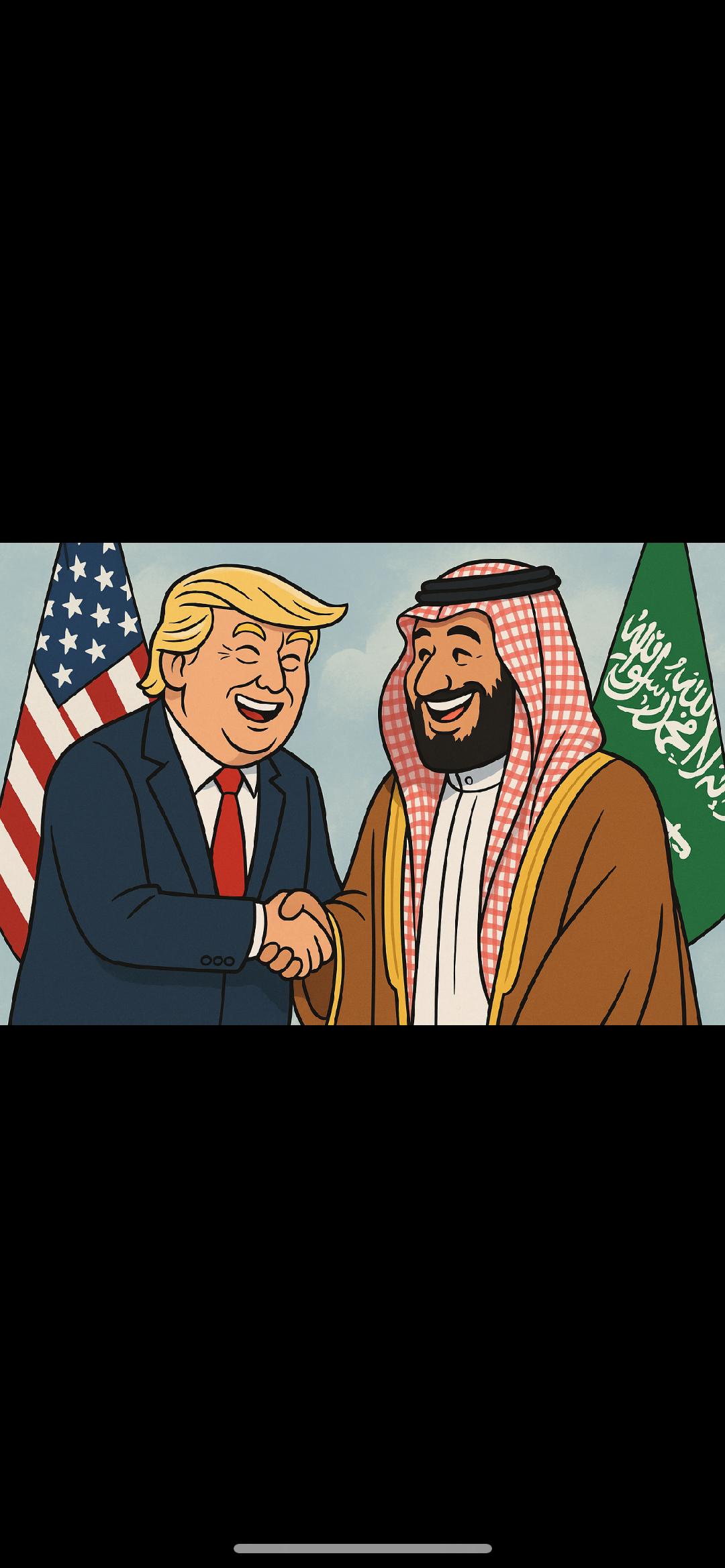
The meeting yesterday at the White House between Mohammed bin Salman and Donald Trump was far more than just another diplomatic, political, or economic appointment: it reaffirmed a personal and political relationship built over nearly a decade. It was in fact in 2016, on the strong recommendation of then–UAE crown prince Mohammed bin Zayed, that Donald Trump met for the first time a young Saudi prince still unknown to the Western public, with no government experience but full of ambition. Both men understood he was destined to shape his country, even though he was not King Salman’s preferred successor. But MBS maneuvered skilfully, consolidated power, and sidelined his rivals. Trump immediately saw in him a relay and a future partner capable of reshaping the regional order. Since then, their friendship has only deepened, despite the scandals—so much so that Trump’s second term resembles a vast international rehabilitation campaign for the Saudi crown prince. MBS is now back at the center of the game, received with great ceremony and without diplomatic precaution. Gone are the Khashoggi affair, the human tragedies of the Yemen war, and Saudi Arabia’s human-rights record.
An Eighty-Year-Old Alliance: From the USS Quincy to the Abraham Accords
To understand yesterday’s meeting, beyond the outrage of human-rights activists, one must return to the original framework: the strategic alliance between Washington and Riyadh, sealed in 1945 aboard the USS Quincy between Franklin D. Roosevelt and King Abdulaziz Al Saud. The fundamental pact has remained the same: Saudi oil in exchange for the American security umbrella. Over the decades, this relationship has survived oil shocks, regional wars, ideological rifts—including over Israel—and Saudi internal transitions. It has been sustained by massive military cooperation, decades of arms sales, counter-terrorism collaboration, and a shared interest: stability in the Gulf. The 2000s reinforced this interdependence—fighting Al-Qaeda, applying pressure on Iran, and behind-the-scenes coordination with Israel. The high point came in 2020 with the Abraham Accords, through which several Arab states normalized relations with Israel. Saudi Arabia did not join, but it blessed the agreement from a distance and positioned itself as the actor that would eventually have to bring the process to its conclusion. This remains the major diplomatic question. It is also a deep ambition for MBS: to develop his country with Vision 2030, just as Israel did with its start-up-nation model, and as the Emiratis and Qataris have done.
From Disgrace to Rehabilitation: MBS’s Turbulent Journey in the West
Mohammed bin Salman has oscillated between Western fascination and harsh rejection. Initially praised for his economic and social modernization program, he became untouchable after the Khashoggi affair in 2018. In Europe, many had pinned their hopes on this young modernizing prince who plays video games and frequents trendy places on the continent. Joe Biden, however, took the opposite stance: he vowed to make MBS an international “pariah” and broke the partnership dynamic, insisting that his only interlocutor in Saudi Arabia was King Salman. Western capitals distanced themselves. The press vilified him. For a time, Riyadh turned to Beijing and Moscow to signal its diplomatic autonomy and aligned itself at high speed with the rising Global South. That chapter is now closed. MBS has been methodically reintroduced into diplomatic circles and is partly back in the American orbit. Europe has received him discreetly, China has offered him an alternative platform, and Washington under Trump once again rolls out the red carpet. The incentives: arms deals and civilian nuclear cooperation, conditioned on recognition of the Israeli state. The image of an impulsive, dangerous prince has given way to that of an indispensable leader in the world’s most combustible region. Whether one likes it or not, no Middle Eastern file can advance without Riyadh.
A Highly Political Visit: F-35s, Arab Leadership, and an Impossible Normalization
The essence of this visit to Washington was predictable: contracts, stability, and cold calculation. MBS wants the F-35s—the crown jewel of American military technology—to cement Riyadh’s military superiority over its regional rivals, especially Iran, weakened by Israeli and American strikes. Trump, true to form, wants to sign, sell, accumulate gains, and stabilize an old but demanding partner. Behind the smiles and courtesies, each plays his part: Trump as salesman-in-chief of the defense industry, MBS as a future king seeking ironclad international legitimacy.
Politically, the meeting cements an established reality: Saudi Arabia has become, whether one likes it or not, the dominant voice of the Arab world. It speaks to Washington, Beijing, Tehran, and Moscow. It also holds the key to normalization with Israel, which Trump is pushing for. The U.S. president dreams of a historic agreement without preconditions. Riyadh, for now, demands a Palestinian state—an essential principle, though highly relative in practice. Normalization will happen sooner or later, but on Saudi terms. After all, MBS has repeatedly said in interviews that Saudis do not particularly care about the Palestinian state—like many Arab governments in reality.
The scene at the White House yesterday embodies a fully assumed diplomacy: Trump praised MBS, minimized human-rights concerns, and piled on the superlatives—not out of naivety but pure realpolitik. The goal is clear: keep a strategic ally in an increasingly unbalanced world, lock in colossal contracts, prevent a Saudi pivot toward other powers, and avoid the interventionist mistakes that have already set the Middle East ablaze—and could do so again. Washington reminded the world of something many had forgotten: the Saudi-American alliance is neither an accident nor a whim. It is a strategic backbone of the international system.