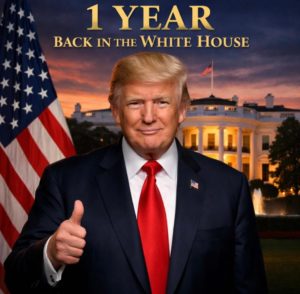
One year after his return to the White House, Donald Trump has methodically rebuilt American foreign policy around his foundational matrix: America First. It is both a slogan and a reality. Beyond the provisional resolution of certain conflicts, the American president now relies on regional powers to delegate and absorb the costs of the post-war order, hoping they will become effective relays. More broadly, this reflects a clear message sent across all continents: each must assume responsibility within its own sphere of influence. One of Trump’s major obsessions is the Europeans’ stubborn refusal to take their destiny into their own hands. Too often we behave like what he calls the “Whining Europeans,” an Europe des Ouin-Ouin that has spent decades resting on America’s shoulder and depending on Washington for its security, instead of building a common and effective one.
Unlike Trump’s first term, during which the system constrained some of the billionaire’s impulses, the second has produced an unambiguous strategic reordering. The publication, a few days ago, of the official U.S. National Security Strategy is its clearest expression: America is returning to itself, refocusing on its exclusive interests, reassessing its alliances based on their real yield, rewriting the hierarchy of priorities, and openly assuming Europe’s growing marginality in global power balances. It now strikes both reluctant allies and adversaries with equal force.
The announcement that caused scandal across the old continent—this idea of an ongoing “European civilizational fading”—is not a gratuitous provocation. It is a harsh but direct formulation of a sentiment long held in Washington: Europe interests the United States only as an adjustable variable and a secondary partner, one that is complex and obsessed with regulation. What shocks Europeans is less the brutality of the language than their inability to hear what Trump has been repeating for eight years. It is clear today that the transatlantic relationship is no longer sacred, nor automatic, nor sentimental. It has become transactional and conditional again, dependent on Europe’s actual ability to matter. This is realpolitik, something we have forgotten how to practice for decades.
The Russia–Ukraine War as a Catalyst
The war between Russia and Ukraine has clearly accelerated this shift. A global conflict serves no one, and economies cannot thrive amid insecurity and permanent political chaos. Europeans, convinced that political solidarity would be enough to guarantee Washington’s long-term commitment, now discover the depth of the misunderstanding. Trump insists that this war is fundamentally a European affair—and says so openly: it is certainly not his war. A war, moreover, that was not truly theirs to begin with, yet in which they are now inextricably entangled without being able to steer it toward peace, or even toward an end.
The reinstatement of punitive tariffs, constant criticism over Europe’s inadequate defense spending within NATO, the now-explicit prospect of a strategic alignment between Moscow and Washington to manage the post-war order—Europe perceives all of this as betrayal. But if betrayal there is, it merely mirrors Europe’s self-deception. Trump acts according to a framework that is coherent and constant: defend American interests above all. It is Europe that deluded itself into believing that this principle would never apply to it.
Europe, Great Lecturer but Small Real Power
Europe’s reaction to the new American doctrine illustrates a structural flaw in our political culture: the unshakeable belief that we embody a universal model. Europeans like to imagine themselves as guardians of the free world, natural producers of norms, architects of global governance, spontaneous champions of human rights. This self-satisfaction—nourished by twenty years of institutional discourse and fiery declarations—barely disguises the essential truth: Europe is no longer at the center of anything. Worse still, it no longer makes anyone dream, despite strong migratory flows and the spread of populist and illiberal regimes worldwide.
We persist in believing that virtue equals power, that regulation equals influence, and that exemplary behavior equals leadership. We still imagine that our model is desirable and that others will eventually conform to it. Yet the world no longer functions this way—not since the collapse of multilateralism, when Europe still had enough institutional weight to maintain the illusion.
Asia has become a new strategic center of gravity. The Middle East is re-emerging as a structuring actor and an indispensable energy reservoir, surviving crises one after another. Africa remains a field of extraordinary competition, with its rare-earth resources and lucrative markets for those who know how to negotiate alliances. Washington, Beijing, and Moscow agree on at least one point: they pay little attention to Brussels. Even Europe’s closest allies now see it more as a market than as a force. And the increasing number of member states taking their own path—far from Brussels’ standards—look instead toward real external state-powers.
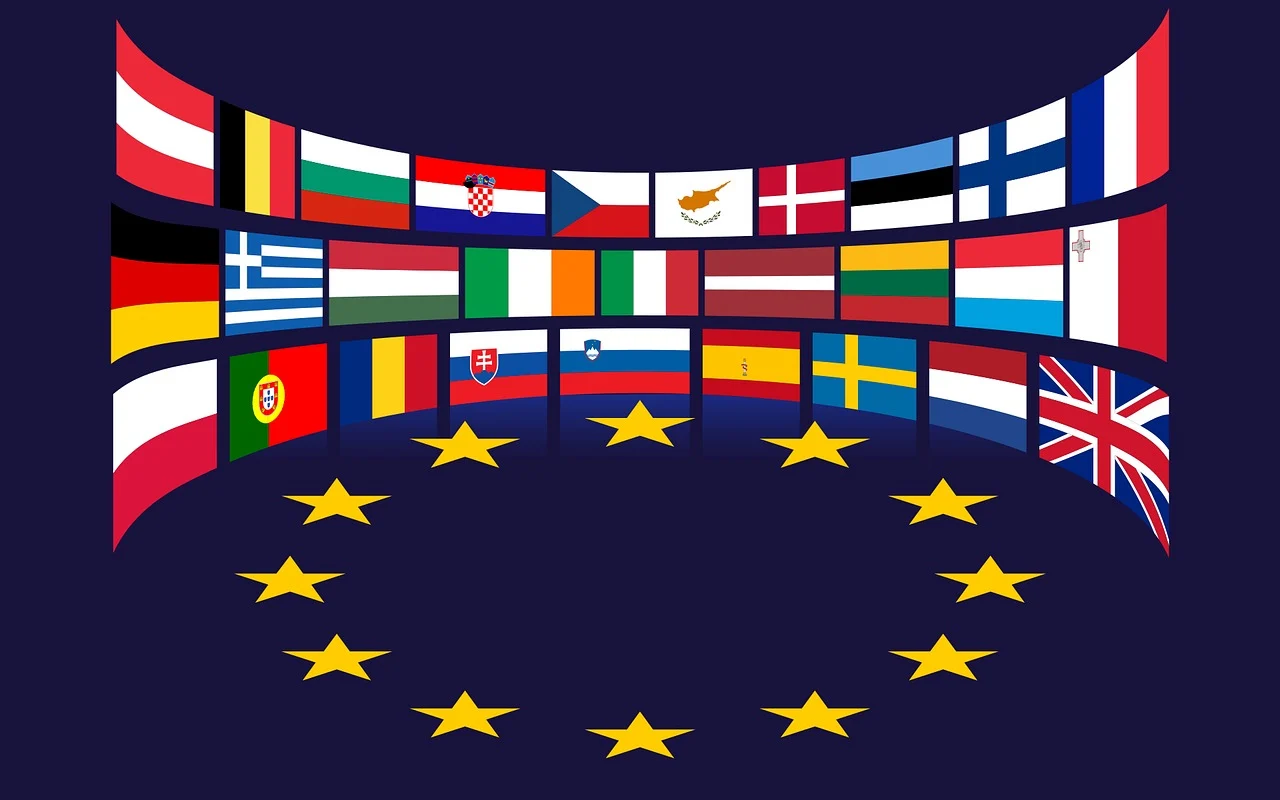
In this context, European irritation at the American document is poorly placed. How can a continent that depends on external powers for energy, on NATO for military security, on Google, SpaceX and Asian manufacturers for technology, and on the political mood of its member states for governance, claim to set the global tempo? Internal fragmentation, institutional quarrels, and impotent moralism have transformed the EU into a rhetorical power—an illusion of power. It talks endlessly, regulates even more, but influences less and less. Europe refuses to admit it has become peripheral. Indignation is not a strategy; it is an emotional response to the loss of a status it no longer has the means to assume. Europe must fight back if it hopes to slow its decline.
Stop Complaining, Start Becoming a Power
The American judgment should be received as an electric shock, not as humiliation. Yes, Washington believes Europe is declining. Yes, Trump judges the Union incapable of assuming its own security. Yes, Europe’s dependency has become untenable. And yes, the time has come for Europe to decide whether it wants to keep complaining or finally strengthen itself.
For a year now, every American decision has forced Europe to confront its own weakness. Whether on trade tariffs, NATO, Ukraine, commerce or intelligence, Europeans discover themselves vulnerable, divided, and incapable of shaping a collective response. Yet a window of opportunity exists. European power will not emerge from speeches but from rupture. Rupture with the permanent temptation to wait for Washington to secure the continent. Rupture with the idea that economic weight alone makes power. Rupture with the comfort of dependency. And as the end of the Ukraine–Russia war approaches—Trump-style—Europe must act.
Europe must now, and absolutely now, decide whether it wants to be in the century ahead a power of illusion or a power of reality. This requires a common defense, a coherent industrial strategy, a unified diplomacy, an assumed energy autonomy, and the acceptance of the return of realpolitik. As the old adage says, in foreign policy we have no friends, only interests.
None of these tasks is impossible. They have simply been postponed for far too long. And paradoxically, it is Donald Trump who today offers the last chance to undertake them. The strategic awakening of the European Union—rich in talent, intellect, and adaptability—will not come from a soft Brussels-style consensus, but from a shock. And this shock, whether one deplores it or admires it, has a name: Donald Trump.
If you want, I can prepare: