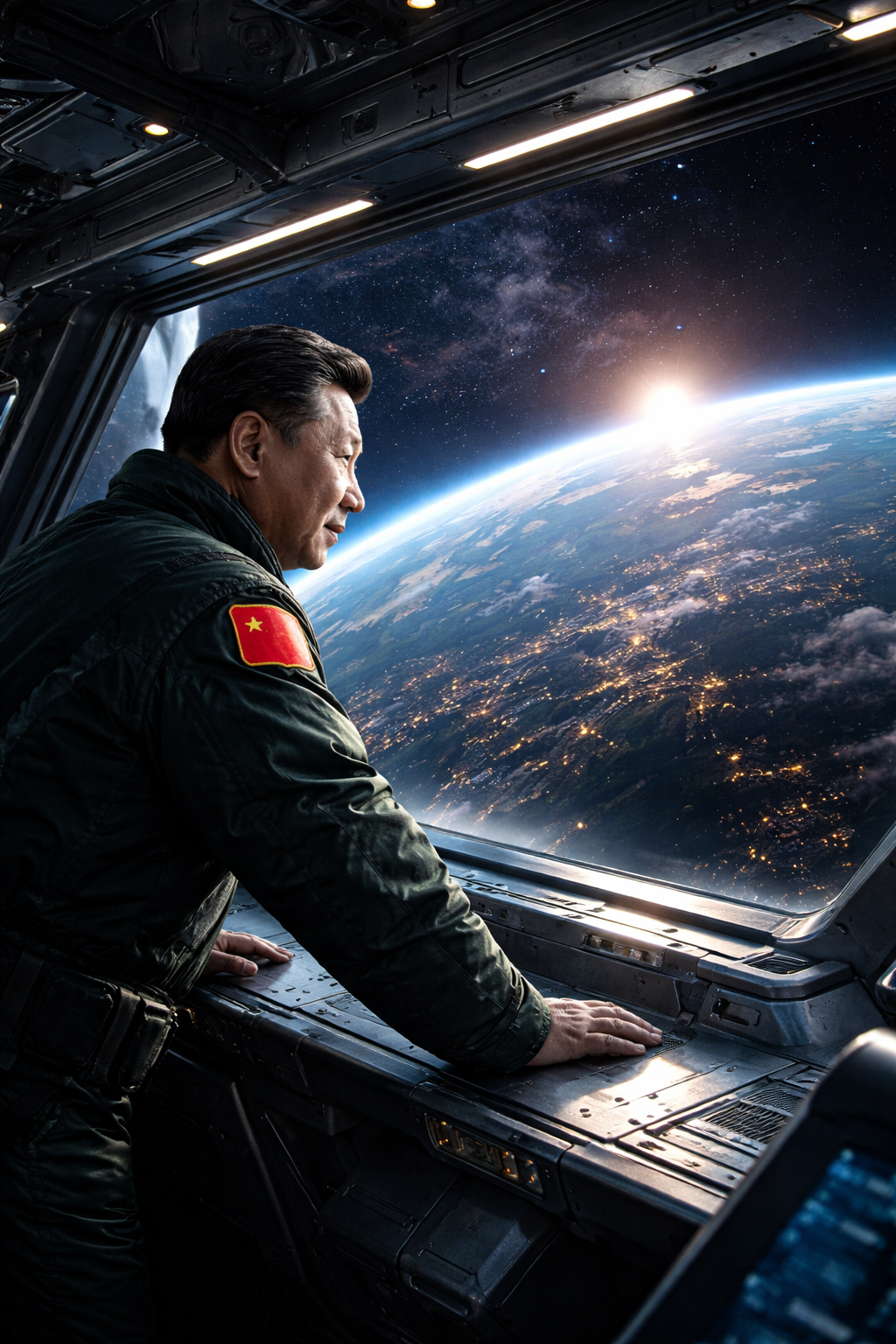
China has recently allowed striking images and concepts to circulate of a futuristic spacecraft straight out of Star Wars, presented as a kind of airborne and spaceborne aircraft carrier capable of operating at the boundary between the atmosphere and low Earth orbit. The visuals spread worldwide, to the point that many assumed they were fake news. The object, with its outsized dimensions and inherently multifunctional role, seems closer to science fiction than to an industrial program that could be realized in the near term. But stopping at that conclusion would be a mistake. Announcements of this kind are not primarily about short-term technical credibility; they are about strategic effect.
Beijing is sending a message and seeking above all to impose a simple idea: space is now a battlefield in its own right, and China intends to occupy a central position there, just as it does on Earth. Whether the project becomes operational tomorrow or in twenty years is almost irrelevant. What matters is shaping the strategic imagination, setting the tempo, and reminding competitors that the boundary between civilian innovation, technological demonstration and military power projection has become deeply porous. Space remains a realm of absolute fantasy, one that all major global powers are striving to conquer.
Space is no longer merely a domain of scientific exploration or a technical support for modern warfare. It has become a vital pillar of state sovereignty, even a potential escape route for the day when life on Earth becomes untenable. Satellites now underpin navigation, communications, intelligence, surveillance, early warning, financial flows and global supply chains. Undermining an adversary’s access to space means blinding its armed forces, disrupting its economy and impairing its political decision-making capacity. The competition is therefore no longer about symbolic feats or spectacular missions, but about control over invisible infrastructures that have become indispensable. In this new geopolitical grammar, space is an inexhaustible force multiplier.
A Decade of Chinese Acceleration to Gain the Upper Hand
Over the past decade, China has methodically built the foundations of a complete, coherent and largely autonomous space power. Launch vehicles, orbital insertion capabilities, navigation systems, Earth-observation satellites, a crewed space station, lunar and Martian exploration—each success feeds the next. Beijing has entered a deliberate strategy of contesting American dominance, with the longer-term ambition of surpassing it.
This rise in power has gone hand in hand with an acceleration in tempo and an upgrade in industrial capacity. Beijing has understood that space power does not rest solely on a handful of emblematic projects, but on the ability to launch frequently, produce at scale, rapidly replace satellites and integrate space fully into its military and economic ecosystem. China’s space station embodies this quest for continuity and independence. Its successive lunar missions reflect an increasingly refined level of technological mastery. The development of satellite constellations and advanced orbital capabilities shows that China is already thinking in terms of resilience, saturation and denial of access—core concepts of contemporary space warfare.
In this context, the concept of a “space aircraft carrier” functions as a new instrument of power and a statement of Beijing’s determination. Visually, it encapsulates an ambition of vertical dominance, from the ground to orbit. China is addressing its competitors, potential partners and its own population alike: it thinks power in the long term and is already projecting itself into the conflicts of tomorrow, including in dimensions that until recently belonged to fiction.
United States vs China: A Fierce Battle for Control of Space
Faced with this rise, competition between the United States and China has become increasingly direct—especially given Elon Musk’s personality and his obsession with Mars. It is no longer a matter of simple technological rivalry or implicit deterrence, but of a structural confrontation between two visions of global power. Washington has acknowledged that space is now a domain of competition in its own right. The creation of a dedicated Space Force, the surge in investment in more resilient satellite architectures and the effort to reduce system vulnerability all reflect a clear strategic awakening. The American objective is to preserve information superiority, protect critical infrastructure and prevent any adversary from acquiring a credible space denial capability.
The fundamental difference between the two powers likely lies in their methods. The United States relies on rapid innovation, massive integration of the private sector and the proliferation of smaller, more numerous and more easily replaceable platforms. China favors a more centralized, state-driven approach, but one that is extremely coherent over the long term. This contrast mirrors broader differences across all domains: an authoritarian Chinese system built for continuity versus a United States shaped by political alternation every four years. One seeks to preserve its lead; the other aims to make that lead unsustainable.
In this race, the European Union appears to occupy an intermediate—if not marginal—position: aware of the stakes, yet constrained by internal divisions, dependencies and a persistent reluctance to fully embrace power politics. Europe nonetheless possesses major assets and high-performing programs. But mastering space is not solely a technical challenge. It requires political will, strategic continuity and an acceptance of conflict. And it is precisely on these fronts that Sino-American competition is most intense. This is pure hard power—and it is where Europe currently falls short.