The international system inherited from 1945 is now going through a phase of sustained tension and instability, to say the least. This situation calls for a clear-eyed diagnosis, free from simplistic or binary interpretations and from the reflex of systematically rejecting the emerging global order. Without falling into defeatism, however. The idea that everything will return to normal once Donald Trump leaves office at the end of his term in 2030 is an illusion. The world is evolving rapidly, in an increasingly uncertain environment, and the balances that once structured the international order are being profoundly challenged, above all because the West itself is being contested as never before.
The post-1945 order was built on a clear ambition: to prevent the return of major conflicts by establishing a system regulated by institutions capable of transcending purely state-based logic. This model, largely shaped by Western powers, now appears weakened, even ill-suited to contemporary realities, especially for many countries that feel neither understood nor represented through the prism of the United Nations and are increasingly drawn to alternative visions promising different futures.
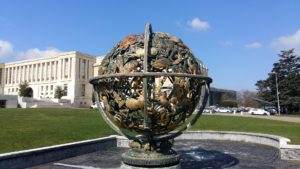
The great capitals of multilateralism such as Geneva, Brussels, or New York City, once symbols of a triumphant multilateral order, now embody its fragility and growing impotence. The concern expressed within them today is not only about internal reforms of international organizations, but about a deeper questioning of their role and effectiveness in a world that has become increasingly multi-multipolar.
Since the early 20th century, the international landscape has been profoundly transformed. The number of states has grown significantly, from around fifty in 1914 to nearly 200 today. Alongside this multiplication of state actors, increasingly influential non-state actors have emerged, capable of shaping or even bypassing multilateral processes: multinational corporations, NGOs, terrorist organizations, and even new forms of emerging political entities such as virtual states. While we have recently witnessed a return of state power, partly to compensate for the weaknesses of multilateralism, who can guarantee that tomorrow populations will still see states as their primary refuge, rather than turning away from them as well? This growing complexity makes the international system more unstable and harder to regulate under rules that now appear outdated. The post-1945 framework maintained a certain level of stability for decades, particularly during the Cold War, but that era now seems to have come to an end. Since the collapse of the Soviet Union in 1990, a profound reconfiguration has been underway.
The Return of Power Politics and the Decline of Multilateralism
This reconfiguration is marked by the return of power politics, leadership rivalries, and the growing assertion of regional powers. The United States seeks to preserve its dominant position in the face of China, while other powers expand their influence within their strategic environments, whether in the Middle East, Africa, Asia, or Latin America.
At the same time, international institutions continue to produce norms, but their ability to enforce them is steadily eroding. The United Nations, once at the center of global regulation, now struggles to assert itself as a decisive actor in managing contemporary crises. A gradual shift is taking place toward a system based more on direct relations between states, characterized by transactional and bilateral logic, precisely the approach favored today by Donald Trump. This trend did not begin with his return to the White House, although it has certainly accelerated and become more visible under his leadership.
Reducing this transformation to the actions of a single leader is both simplistic and misleading. One may strongly oppose Trump, for many legitimate reasons, but the analysis must go beyond that. The prioritization of national interests is now a shared constant among all major powers challenging the current order, whether the United States, China, Russia, or Iran. In this fragmented concert of nations, European populations increasingly feel unprotected, exposed to the ambitions of competing powers. There is no room for naivety: perception matters, and who can seriously claim that Vladimir Putinprioritizes his citizens’ interests more than European leaders attempt to do? Especially when one considers that behind Europe’s apparent economic and normative strength lies a lack of real sovereignty in key domains such as energy, digital infrastructure, and defense.
At its core, the issue is one of trust. Like currency, multilateralism relies on collective belief. Yet this belief has been eroding for decades. The key question is therefore whether we are facing a crisis of confidence or a structural inability of international institutions to respond to today’s challenges. The system is increasingly moving toward a form of disintermediation, where states settle disputes directly, outside multilateral frameworks. While this may sometimes produce short-term results, it raises serious questions about the durability of such agreements. We are clearly living in an in-between moment of international order.
Toward a Divided but Reconfigured World
Recent events illustrate this fragility: the war in Ukraine, tensions in Central Africa, the rapprochement between Iran and Saudi Arabia mediated by China, or ongoing peace initiatives in the Middle East. These dynamics reflect both an ongoing recomposition and persistent instability.
This evolving environment is accompanied by the return of bloc dynamics and spheres of influence. Russia in Ukraine, China around Taiwan, and Iran through its regional networks all demonstrate a willingness to expand influence zones, with direct consequences for regional balances.
At the same time, the so-called “Global Souths” are asserting themselves as structuring forces in this new order. Their approach is not limited to opposing the West. It also involves proposing alternatives, whether through new forms of cooperation, monetary initiatives, or strategies of de-dollarization. While a coherent long-term strategy may still be difficult to grasp, it is clear that this world is gaining weight, economically but above all demographically. This is their primary lever: while demographic decline is a major issue in the West, many countries in the East are not facing the same crisis.
From a security perspective, organizations such as the Shanghai Cooperation Organization illustrate the effort to structure an alternative order, while still retaining certain elements of multilateral cooperation. With nine member states, including China, Russia, India, Pakistan, Kazakhstan, Uzbekistan, Kyrgyzstan, Tajikistan, and Iran, as well as numerous observer and partner states, the organization represents between 3.3 and 3.5 billion people, roughly 40 to 45% of the global population. This is a considerable weight.
The world taking shape is not one in which the West disappears entirely, but one in which power is profoundly rebalanced. This transition opens a period of uncertainty, but also of recomposition, whose contours remain largely undefined. Europe, meanwhile, continues to lament and accuse the United States of undermining its future, without fully grasping the deeper civilizational stakes at play. All Western countries should instead navigate between diplomacy and assertive action to maintain influence, resist decline, and remain relevant.
Because the reality is clear: we are facing geopolitical bulldozers that have turned our own tools against us. Regulation, diplomacy, and even military power are meaningless without full sovereignty. The time has come to wake up, or this may truly mark the beginning of the end of the West. And perhaps, paradoxically, Donald Trump will have at least contributed to that awakening.