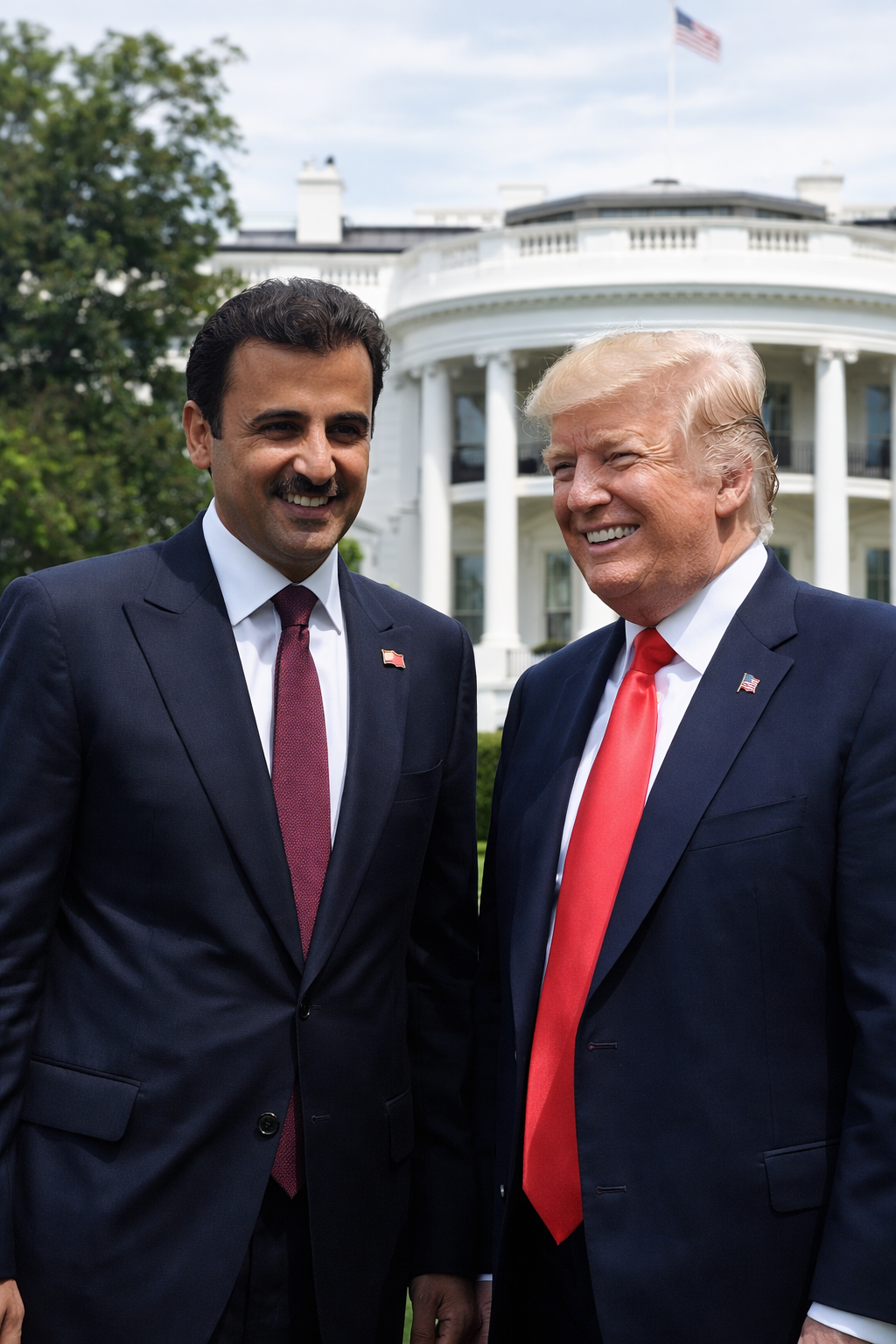
Just a few hours before Benjamin Netanyahu’s arrival at the White House last February 14, the phone call on Tuesday, February 11, between Donald Trump and the Emir of Qatar, Tamim bin Hamad Al Thani, was anything but insignificant. It came amid extreme regional volatility, as the files of Gaza, Iran and the security of U.S. bases in the Gulf intersect in increasingly dangerous ways. In an exceptionally tense regional context, the exchange focused on efforts toward regional de-escalation, the continuation of ongoing mediation efforts, and the need to keep channels of dialogue open with actors Washington no longer wishes to confront directly. While Israel seeks to increase pressure on Iran to the point of military intervention, Qatar, alongside its Gulf neighbors, is advocating negotiation.
This simple phone call, the latest in a series of reconciliations and gradual rapprochements between the two countries, says much about the strategic reversal now underway. In 2017, Qatar was publicly branded by Trump and his entourage as a hub of terrorism, blamed for every regional ill and subjected to a brutal blockade by its Gulf neighbors, with Washington’s tacit approval. Eight years later, the very same Trump is relying on Doha as a key interlocutor to manage the most explosive crises of the moment. This shift is neither accidental nor circumstantial. It is the result of a long-term strategy pursued by Doha, based on resilience, diversification of alliances and a diplomacy of mediation that has become indispensable even to the United States itself.
2017–2021: The Blockade Years, or the Making of Strategic Autonomy
The blockade crisis triggered in 2017 was a violent and largely unforeseen shock for Qatar. Within days, the emirate found itself isolated from its immediate environment, pressured to abandon its autonomous foreign policy, its relations with certain non-state actors and its multi-directional diplomacy. The Trump administration at the time accompanied this ostracism with a harsh and ideological discourse, without fully grasping the systemic effects of such a strategy. Yet where many predicted collapse, Doha rebounded.
The blockade accelerated a transformation already underway: securing supply chains, strengthening logistical partnerships with Turkey and Iran, expanding multilateral diplomacy and consolidating its role as a platform for dialogue. Far from retreating, Qatar stepped into the diplomatic vacuum left by others. It continued to speak to everyone, including actors Washington no longer wished to engage directly. Paradoxically, this period enhanced Qatar’s strategic value for the United States. Despite political tensions, and even as U.S. troops gradually withdrew from Iraq, the Al Udeid air base remained a central pillar of American military projection in the Middle East. This contradiction—between political rhetoric and security reality—eventually caught up with Washington.
Biden, Then Trump Again: Strategic Continuity Beyond Political Ruptures
With Joe Biden’s arrival in 2021, U.S.–Qatari relations warmed significantly. Doha became a key partner on several sensitive issues, from Afghanistan to Gaza, including the management of indirect channels with Iran. The Western withdrawal from Afghanistan could not have taken place without Qatar’s logistical and air support. Qatar established itself as a credible mediator precisely because it spoke to everyone, without ideological posturing and without seeking to impose a normative agenda.
What stands out today, however, is the continuity of this relationship despite Trump’s return to the political scene. Rather than reviving the hostilities of 2017, Trump has chosen to rely on Doha. In an explosive Middle East marked by asymmetric conflicts and powerful non-state actors, the United States needs solid intermediaries capable of absorbing the political cost of dialogue. This also serves as an insurance policy in the event of a total and definitive U.S. disengagement, as Trump has promised.
The September 2025 crisis nevertheless put this relationship to the test. When the U.S. administration failed to warn Doha of a targeted Israeli strike on its capital, the shock reverberated across the Gulf. The objective was to eliminate Hamas operatives with whom Qatar negotiates on behalf of both the United States and Israel. Beyond the incident itself, it was the credibility of the American security umbrella that wavered. Gulf capitals briefly contemplated a scenario long considered unthinkable: an America willing to jeopardize the security of its closest partners without consultation. This moment marked a profound psychological rupture. And yet Qatar did not break. It absorbed the shock, protested without overplaying its hand, and continued its role as mediator. Once again, Doha chose strategy over instinctive reaction, despite serious existential fears.
Doha, an Indispensable Relay of a Constrained American Diplomacy
The recent phone call between Trump and the Emir fits squarely into this logic. Washington is now delegating to Doha dossiers it can no longer—or no longer wishes to—handle directly. Gaza is the most visible example. Qatar has become the central interlocutor for indirect dialogue with Hamas, not out of ideological affinity, but out of pragmatism. The same applies to certain African mediations, notably between the DRC and Congo, where Doha has emerged as a discreet facilitator far from the Western spotlight. The Iranian file is following a similar trajectory. While direct confrontation remains a costly and risky option, Qatar offers a credible communication channel, accepted by Tehran and tolerated by Washington.
This role is not neutral. It exposes Doha to pressure, to criticism it has long grown accustomed to, and to genuine security risks. But it also grants the emirate a level of strategic centrality that few regional actors can claim.
Comparison with other Gulf partners is instructive. Saudi Arabia is a major U.S. ally, but it rarely acts as a mediator in complex crises. Oman, historically neutral, plays a valuable but more discreet role, often limited to technical facilitation. Qatar, by contrast, combines initiative, diplomatic risk-taking and security alignment with Washington. It is this combination that makes it an essential anchor point. In a world where American diplomacy is increasingly challenged, regional intermediaries are no longer secondary options. They are power multipliers. By choosing to renew and strengthen dialogue with Doha, Trump is not merely correcting a past mistake. He is acknowledging a strategic reality that has become unavoidable: in the Middle East, crisis resolution no longer relies solely on force or traditional alliances, but on states capable of speaking to everyone without relinquishing their own sovereignty.